Log forms
Logging is a first-class feature of the framework: successful runs are logged, not only failures. All log forms are under External integration → Inquiries.
Export document log
Form: DEVIntegExportDocumentLog
The log for event-based outbound integrations. When a business event happens (for example, a purchase order confirmation), a record with a reference to the source document is created here with status To send. The Export messages from log periodic operation (or an immediate call in the user session) sends the payload and flips the status to Sent.
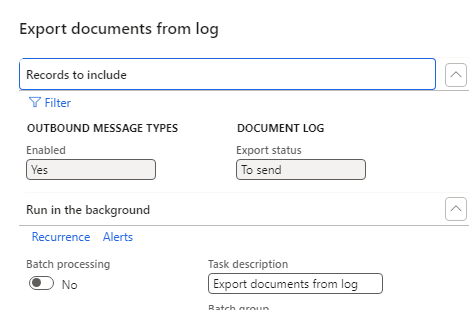
Design notes:
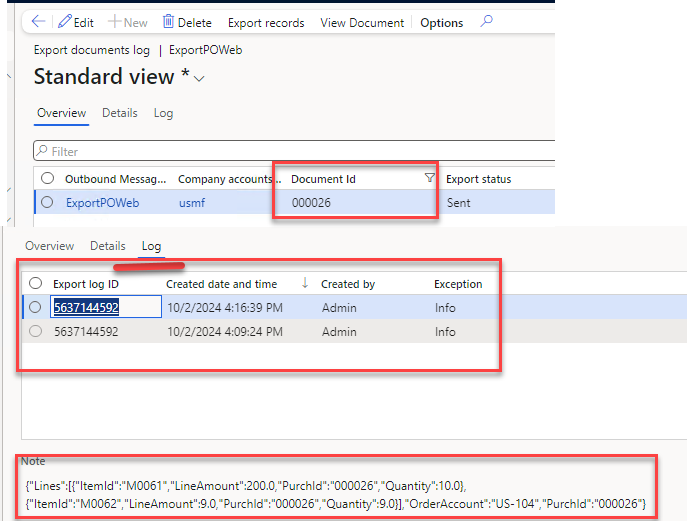
- There are deliberately only two statuses — To send and Sent. A failed export stays in To send with an attached error log; from a business point of view "not exported yet" and "export failed" need the same attention. Set up alerting on records staying in To send longer than your threshold.
- With full logging enabled, the exact message body sent to the external system is stored on the log record.
- The Document ID field gives the full export history of one document — the tool for investigating "the receiver says it never arrived" cases.
Export log (bulk)
Form: DEVIntegExportBulkLog
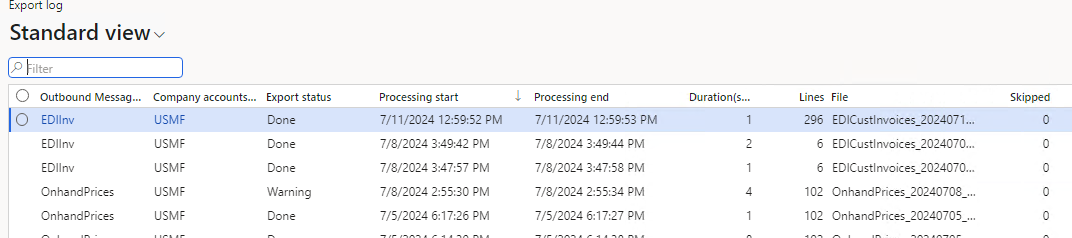
The log for periodic (bulk) exports: one record per run with the generated file name, number of exported lines, duration, and warning/skipped counters.
Last load call log
Form: DEVIntegLastLoadCallLog
Diagnostic history of Load messages calls per inbound message type — when the last load ran and what it returned. Combined with an alert on the message type's Last date time field, it detects both a failing load job and a load job that silently stopped running.
Service call log
Form: DEVIntegServiceExportLog
The log for service message types. The logging level is configurable per service:
- None — no logging.
- Statistics & Errors — one summary record per day for successful calls (total calls and lines), plus a detailed record for every failed call.
- Errors only — detailed records only for failures.
- Request — also stores the incoming request parameters.
- Full logging — stores requests and full responses.
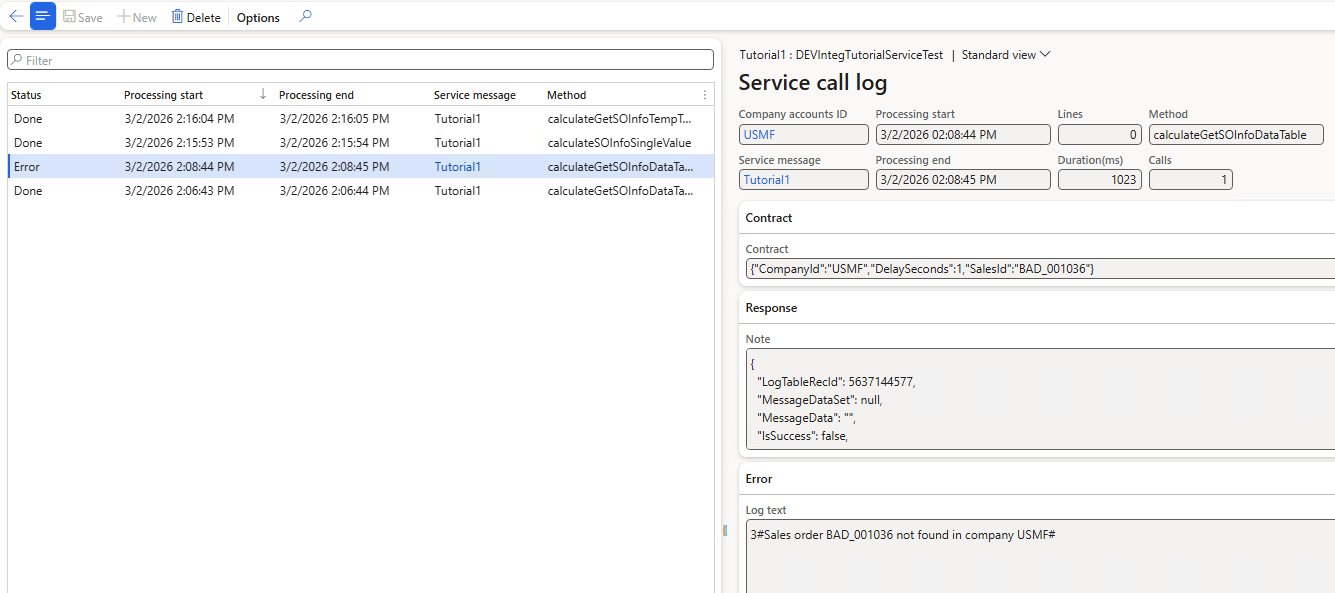
Statistics-based levels keep the log compact for high-frequency services while still giving daily volume numbers for monitoring.